

Current Issue
Current Supplement
State of Pharmacy Compounding 2024
April 2024
Empower Yourself
PP&P gives you the knowledge you need when you need it.
Subscribe Now
Already a subscriber? Sign in here
Recent Articles

With the November 2023 enforcement date for the USP Chapter <797> updates, it is more important than ever to ensure regulatory changes are incorporated throughout healthcare facilities—especially when considering the assignment of beyond-use dates (BUDs) to compounded sterile products (CSPs). The updated chapter takes into consideration both the stability and sterility of the CSPs utilizing... Read more

Pharmacy Purchasing & Products recently held a webinar entitled: State of Pharmacy Compounding Update 2023Presented by Fred Massoomi PharmD, BCSCP, FASHP The following questions were submitted by attendees. The webinar slides and full presentation can be downloaded at pppmag.com/webinars.
Q: With competency testing for hazardous drug compounding, do media fills need to include the... Read more

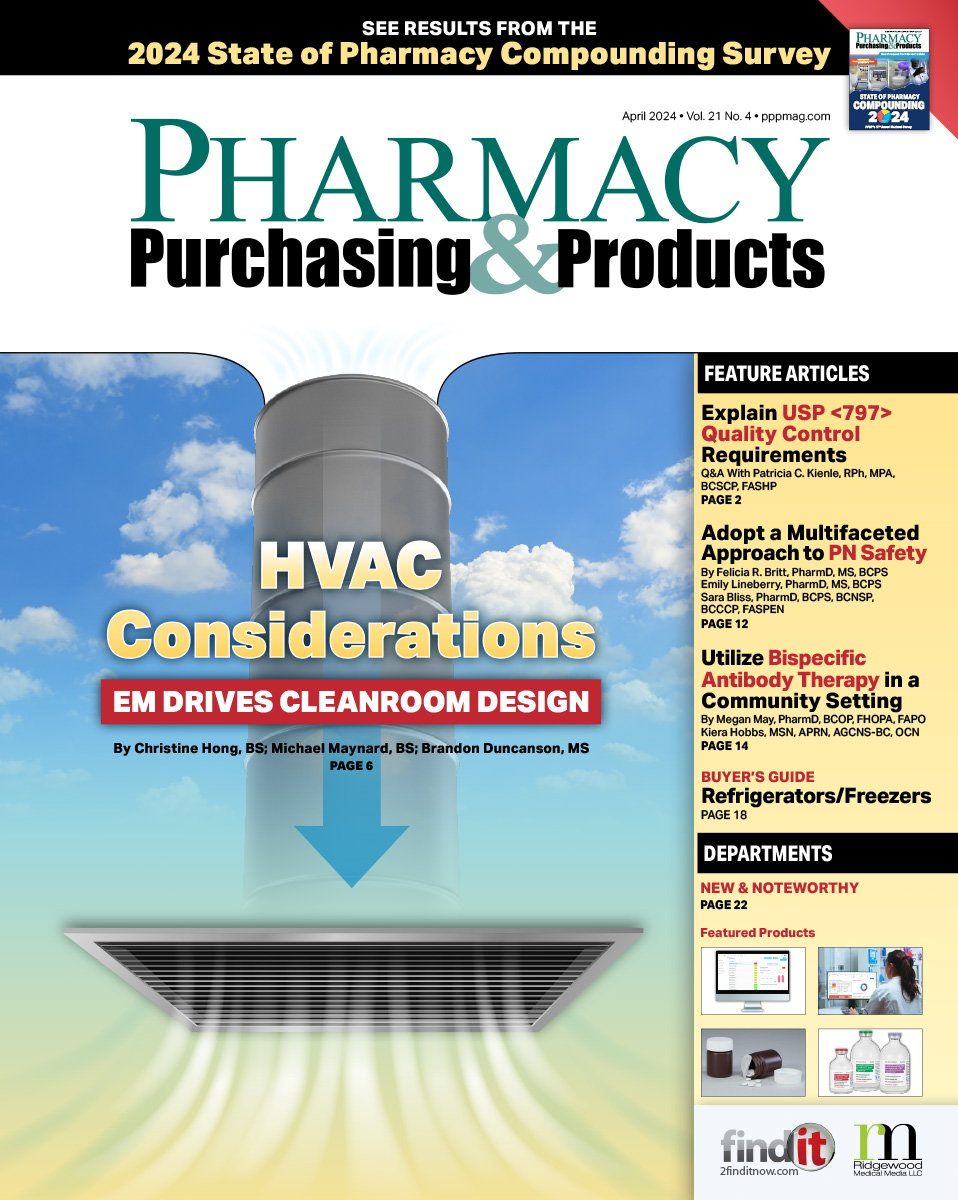
While HVAC related elements and primary engineering controls (PECs) are vital factors in cleanroom design, day-to-day operations must hold equal weight in the planning process. Optimizing door locations, placing demarcation lines, and storage and material introduction are examples of processes that require careful thought in early design stages. The July 2023 article, EM Drives Cleanroom Design Part... Read more

The pharmacy technician shortage remains an ongoing challenge across the country.1 If left unattended, chronic labor pool shortages among pharmacy technicians can lead to an unbalanced, fragmented workforce. For example, when individual technician training is cut short to allow that individual to assume the role they were intended to fill as early as possible, this may cause long-term, unintended... Read more

Operating rooms (ORs) and procedural areas present unique diversion risks due to fast paced workflows and the large quantity of controlled medications used therein. Staff in these settings tend to focus on their own tasks, presenting opportunities for colleagues to divert undetected. Because of this, developing a diversion audit plan for OR and procedural areas can be a frustrating task. Particularly... Read more
Recent Popular Articles





Current Issue
© 2005 - 2024 PP&P Magazine - Pharmacy Purchasing & Products.
All rights reserved.